Pessimists walk out, optimists cry marketing: the AI debate is about interpretability, not capability
The two camps have argued about AI for decades, but the technology is not what they disagree about. Precise interpretability of LLMs is still out of reach, and the resulting doubt about controllability cuts both ways: it may also mean we…
01 / The pessimists: from outside warnings to insiders walking out
AI pessimism has never been absent, and the people raising the alarm have moved steadily inward. In 2015 they were co-signing the Pause Giant AI Experiments open letter. By 2023, Turing Award winner Hinton had left Google to warn in public. Bengio keeps returning to the same line: we cannot control things smarter than ourselves. The turning point came in 2024, when both leads of OpenAI's Superalignment team, Ilya Sutskever and Jan Leike, left. Leike said publicly that the company's safety culture had taken a backseat to shiny products, and the team was disbanded soon after. Co-founder Schulman moved to Anthropic to keep working on safety. Once the doomsday warning comes from the people who built this wave instead of from outsiders, pessimism stops being a fringe voice you can wave away.
02 / The optimists: fear narratives and regulatory capture
On the other side, Andrew Ng laid out a systematic rebuttal in a recent interview (full transcript in Chinese). Much of the fear messaging of the last two or three years, he argues, traces back to a handful of leading companies using regulatory capture to lock in an uneven playing field: spend a few billion dollars training a model and you hardly want anyone giving away open alternatives for free. The nuclear-weapons comparison has, in his words, no factual basis. His evidence is empirical. Break a job into tasks and AI handles roughly 30%–40% of them, with the rest complementary to it rather than replaced. Software engineering, the role with the most exposure, is seeing demand rise. He also names a human context advantage: years of accumulated tacit knowledge has no pipeline into the model, and that gap is the technical substance of judgment and taste. LeCun and Andreessen go further. LeCun treats the LLM as a step rather than a destination and thinks existential risk is overrated; Andreessen states flatly that AI will save the world.
03 / Where the split actually comes from: interpretability is out of reach
Put the two camps side by side and the consensus outweighs the disagreement. Both sides agree that LLMs are black boxes. Nobody can explain precisely why a model produced this sentence, or whether it will produce the same one next time. The optimists are betting on an engineering loop: deploy, measure, improve. Andrew Ng reaches for the airplane. A plane is never perfectly controllable and wind pushes it off course, yet flying is safe enough every day. The pessimists attack the premise of that loop. Every step of aviation rests on verifiable aerodynamics and engineering standards, while LLMs cannot even be attributed internally with precision, so the ruler you would use to decide what "expanding gradually in a controlled environment" means is itself blurry. The fear is not aimed at what AI can do; it is aimed at our inability to explain it precisely. Interpretability stays out of reach, and controllability you cannot be confident in follows directly. The line Leike left with, that we urgently need to figure out how to steer and control systems much smarter than us, is about that unfinished ruler.
04 / The bigger risk: underestimating the leap
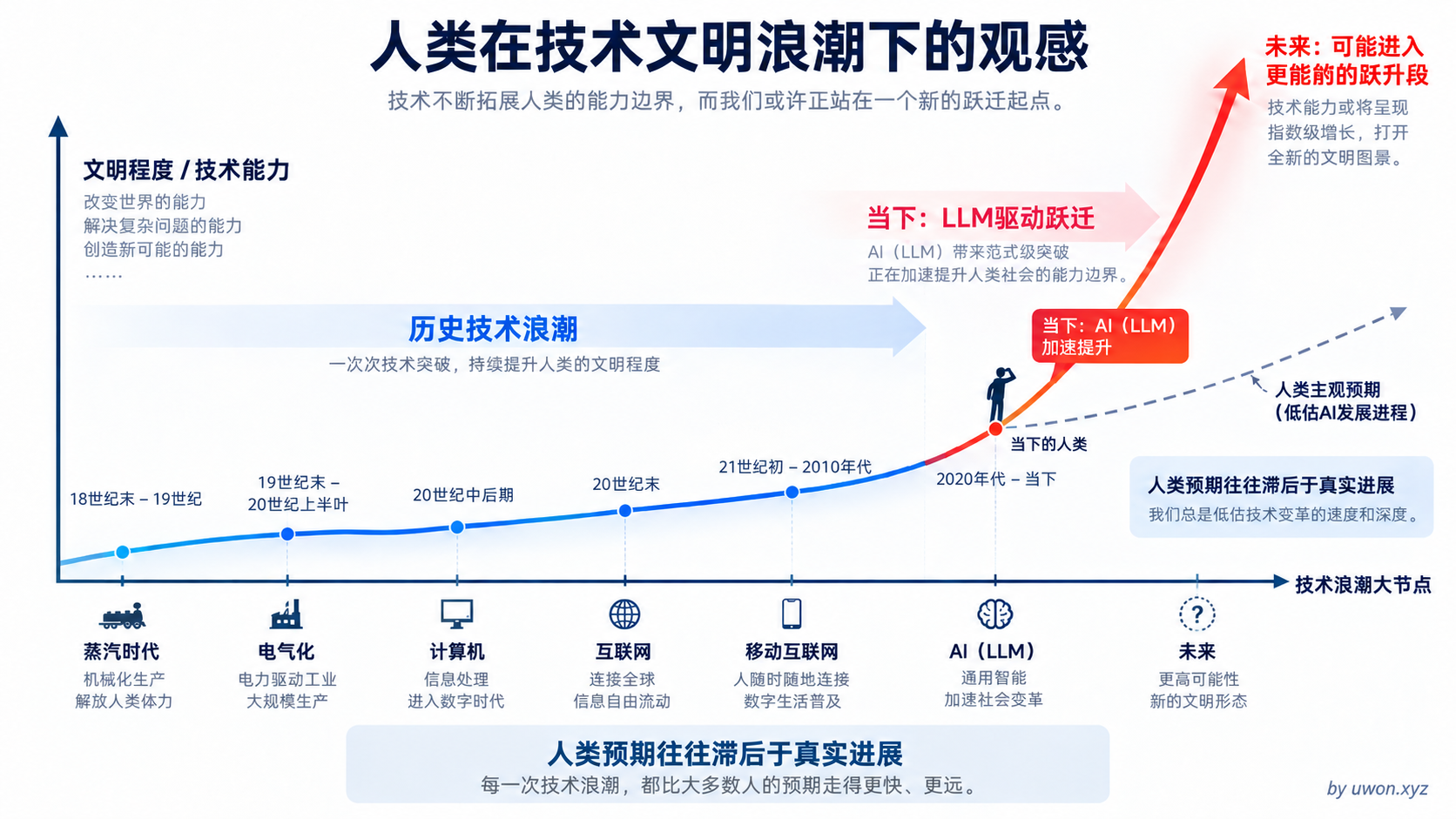
The louder the two camps argue, the more they point at one fact: the AI capability curve is steeper than most people expect. In every previous technology wave, from steam and electricity to computers, the internet and mobile, public expectations lagged real progress. The jump LLMs are driving is no exception, and the lag runs wider. Pessimism also has a second reading. Precisely because we cannot yet explain the models we have, we are unsettled about where their capability ceiling sits a few years out. That unease may itself reflect how broadly we underestimate the size of the coming capability leap. What needs managing is not fear or optimism, not which emotional side you pick, but preparation speed: whether safety engineering, institutions, education and your own skills can keep up with the curve.
References: Baoyu on Weibo, full Andrew Ng interview transcript / Leike's public resignation letter / FLI open letter / NYT Hinton interview / a16z, Why AI Will Save the World. All are linked inline above.